⚡ Executive Clinical Summary (Key Takeaways)
- The Primary Driver: Progressive accumulation of structurally damaged, reactive-oxygen-producing mitochondria (dysfunctional organelle burden) directly drives cellular senescence and micro-inflammation.
- The Master Regulators: Sirtuin-1 (SIRT1), AMP-activated protein kinase (AMPK), and Peroxisome proliferator-activated receptor gamma coactivator 1-alpha (PGC-1α) form the primary triad controlling mitochondrial biogenesis.
- Targeted Clearance: Activating PINK1/Parkin-mediated mitophagy clears senescent organelles before they initiate the senescence-associated secretory phenotype (SASP).
- Integrative Approach: Combining lifestyle cues like circadian fasting protocols and thermal adaptation with targeted botanical mitophagy inducers and cellular bioavailability optimizes bioenergetic reserve.
The biological trajectory of human aging is fundamentally constrained by mitochondrial bioenergetics. While historical gerontology often viewed mitochondrial decay merely as a passive consequence of chronic oxidative stress, modern molecular medicine identifies organelle degradation as an active, regulated driver of the epigenetic and structural hallmarks of aging.
1. The Bioenergetic Deficit: Structural Degradation vs. Functional Clearance
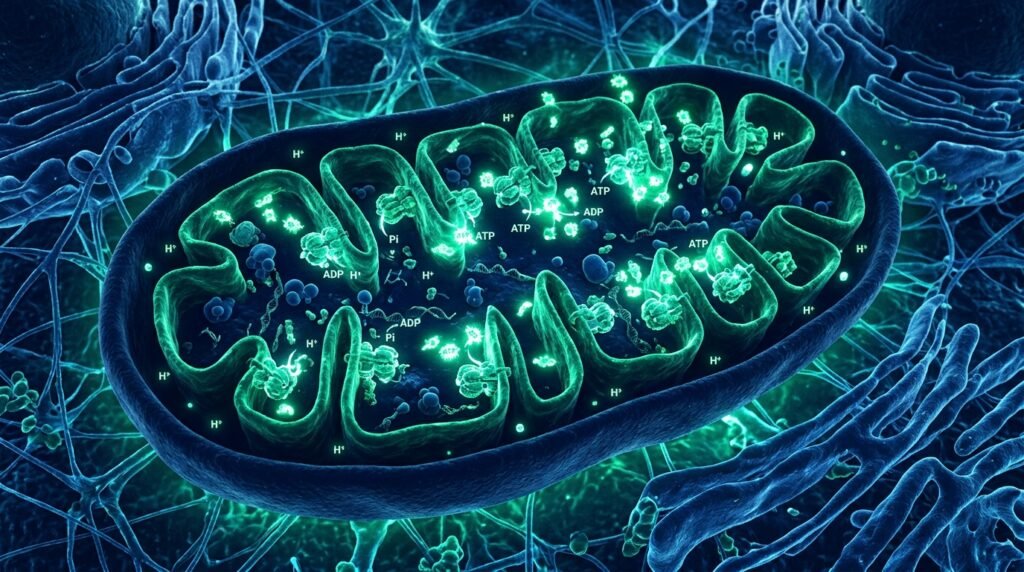
At the center of cellular exhaustion lies an imbalance between organelle genesis and organelle disposal. Healthy somatic cells continuously undergo mitochondrial fission and fusion to isolate dysfunctional segments of the reticular network. When membrane potential (ΔΨm) collapses below physiological thresholds, the serine/threonine kinase PINK1 accumulates on the outer mitochondrial membrane, recruiting the E3 ubiquitin ligase Parkin.
In senescent tissues, this selective autophagic clearance—known as mitophagy—is systematically downregulated. The resulting persistence of bioenergetically uncoupled mitochondria leads to systemic ATP deficits, compensatory hyper-glycolysis, and uncontrolled leakage of mitochondrial DNA (mtDNA) into the cytosol, triggering the cGAS-STING inflammatory cascade.
2. Molecular Pathways Regulating Organelle Turnover
The longevity axis operates through three tightly coupled molecular checkpoints:
3. Translating Mitochondrial Science to Clinical Longevity Protocols
Interventional geroprotection requires a dual strategy: pulsed metabolic stress to induce autophagic clearance, followed by substrate repletion to support organelle biogenesis. Clinical data demonstrate that continuous unmitigated suppression of mTOR impairs tissue repair; therefore, rhythmic cycling between cellular catabolism and anabolism represents the gold standard protocol.
Clinicians monitoring metabolic longevity frequently evaluate biomarkers including fasting serum insulin, high-sensitivity C-reactive protein (hs-CRP), and skeletal muscle respiratory capacity (VO2 max) as surrogate indicators of mitochondrial efficiency.
Frequently Asked Questions (Clinical & Scientific FAQ)
❓ How does mitophagy directly prevent cellular senescence?
Mitophagy systematically dismantles depolarized mitochondria before they release cytotoxic quantities of reactive oxygen species and cytosolic mtDNA. By preventing persistent oxidative damage to telomeres and nuclear chromatin, mitophagy halts the transition of metabolically active cells into permanent senescent arrest.
❓ What is the relationship between NAD+ availability and mitochondrial health?
Nicotinamide adenine dinucleotide (NAD+) is an indispensable co-substrate for sirtuins (SIRT1-SIRT7). As intracellular NAD+ declines with chronological age—driven primarily by CD38 hyper-activation—sirtuin activity drops, preventing the deacetylation and subsequent activation of PGC-1α, which halts organelle biogenesis.
❓ Can exercise stimulate mitochondrial biogenesis at any age?
Yes. High-intensity interval protocols and progressive zone-2 endurance exercise generate acute spikes in cellular AMP, directly activating AMPK and stimulating PGC-1α transcription even in octogenarian cohorts.
Peer-Reviewed References & Evidence Citations:
- Sun, N., et al. (2016). The Mitochondrial Basis of Aging and Age-Related Disorders. Molecular Cell, 61(5), 654-666. PMID: 26942670. DOI: 10.1016/j.molcel.2016.01.028.
- López-Otín, C., et al. (2023). Hallmarks of aging: An expanding universe. Cell, 186(2), 243-278. PMID: 36599349. DOI: 10.1016/j.cell.2022.11.001.
- Cantó, C., & Auwerx, J. (2009). PGC-1alpha, SIRT1 and AMPK, an energy sensing network that controls energy expenditure. Current Opinion in Lipidology, 20(2), 98-105. PMID: 19276888.