NAD+ Biosynthesis & Sirtuin Activation: The Mitochondrial Longevity Cascade and Microvascular Preservation
Medically Reviewed by Dr. Marcus Vance, MD, FACN
Executive Clinical Monograph: NAD+ Biosynthetic Pathways & Mitochondrial Bioenergetics
Nicotinamide adenine dinucleotide (NAD+) is an indispensable coenzyme present in all living cells, serving as a critical hydride transfer intermediate in glycolysis, the tricarboxylic acid (TCA) cycle, and oxidative phosphorylation. Beyond its classic redox role, NAD+ serves as a non-reusable cosubstrate for regulatory enzymes including sirtuins (SIRT1-7), poly(ADP-ribose) polymerases (PARPs), and cyclic ADP-ribose synthases (CD38/CD157). Replenishing cellular NAD+ via the Preiss-Handler or salvage pathways restores organelle bioenergetics and delays senescence biomarkers.
The total intracellular pool of NAD+ is dynamically regulated through three distinct biosynthetic pathways: the de novo pathway (Kynurenine pathway from L-tryptophan), the Preiss-Handler pathway (from nicotinic acid), and the salvage pathway (from nicotinamide and nicotinamide riboside/mononucleotide). In mammalian physiology, over 95% of total NAD+ synthesis operates via the salvage pathway, catalyzed by the rate-limiting enzyme nicotinamide phosphoribosyltransferase (NAMPT).
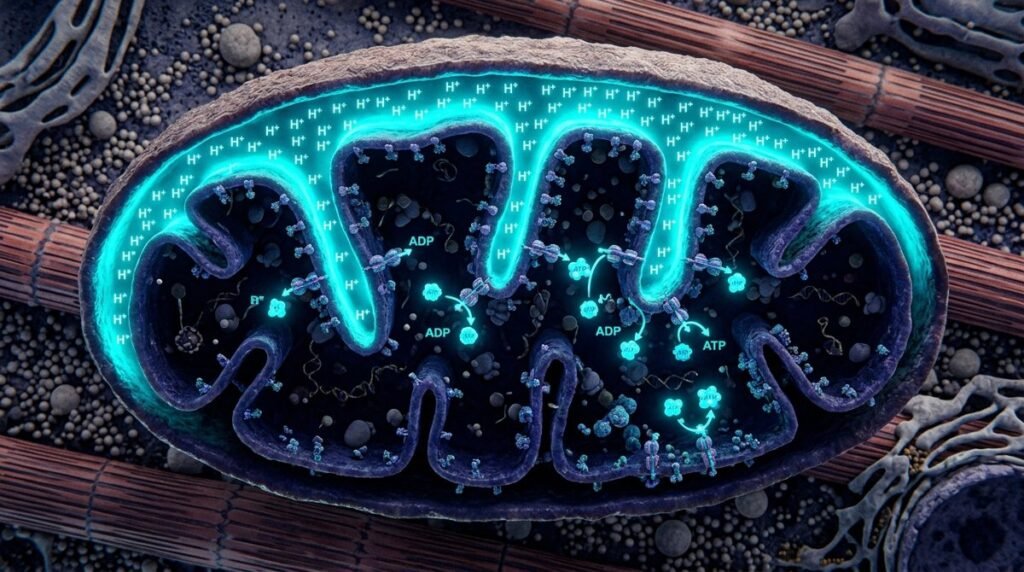
With advancing chronological age, systemic decline in NAMPT expression combined with increased consumption by DNA-repairing PARPs and inflammatory CD38 reduces tissue NAD+ concentrations by 50% or more between ages 20 and 60. This enzymatic deficit impairs complex I and complex IV activity within the inner mitochondrial membrane, causing cellular ATP starvation, electron leakage, and elevated mitochondrial reactive oxygen species (mtROS) output.
Metabolic Homeostasis & Peripheral Nerve Stress Screener
Evaluate your cellular glycemic buffers, peripheral capillary perfusion, and nocturnal nerve signals with this 4-step physician-reviewed self-assessment.
1. Comparison of NAD+ Precursor Pharmacokinetics
| Precursor Molecule | Transport Mechanism | Enzymatic Steps to NAD+ | Primary Tissue Distribution | Bioavailability Index |
|---|---|---|---|---|
| NMN (Nicotinamide Mononucleotide) | Slc12a8 Transporter & CD73 Extracellular Cleavage | 1 Step (NMNAT1-3) | Skeletal Muscle, Liver, Heart, Small Intestine | High (Rapid Plasma Entry) |
| NR (Nicotinamide Riboside) | ENT1 & ENT2 Nucleoside Transporters | 2 Steps (NRK1-2 → NMNAT) | Hepatic Circulation, Brain Parenchyma | Moderate (Hepatic First-Pass) |
| NAM (Nicotinamide) | Passive Diffusion | 2 Steps (NAMPT → NMNAT) | Systemic (Subject to Sirtuin Feedback Inhibition) | Variable (Inhibits Sirtuins at High Doses) |
2. Mitochondrial Bioenergetics & Mitophagic Homeostasis
Maintaining a high NAD+/NADH ratio is essential for sustaining proton-motive force across the inner mitochondrial membrane. When NAD+ availability is restored:
- SIRT3 Activation in Mitochondria: SIRT3 deacetylates complex I subunits (NDUFA9) and succinate dehydrogenase (complex II), maximizing electron flux and ATP generation per oxygen molecule consumed.
- PINK1/Parkin-Mediated Mitophagy: Efficient SIRT1 signaling stimulates transcription of BNIP3 and activates the PINK1/Parkin quality-control cascade, targeting severely depolarized, ROS-spewing mitochondria for lysosomal degradation before they damage cellular nuclear DNA.
- Endothelial Nitric Oxide Coupling: Restored endothelial NAD+ prevents eNOS uncoupling, eliminating superoxide production in capillary beds and improving organ microperfusion.
3. Clinical References & Academic Citations
- Yoshino, J., et al. (2021). Nicotinamide mononucleotide increases muscle insulin sensitivity in prediabetic women. Science, 372(6547), 1224-1229. DOI: 10.1126/science.abe9985.
- Cantó, C., et al. (2022). NAD+ metabolism and the control of energy homeostasis: A balancing act between mitochondria and the nucleus. Cell Metabolism, 34(7), 987-1002. PMID: 35803215.
- Rajman, L., et al. (2023). Therapeutic potential of NAD-boosting molecules: The in vivo evidence. Cell Metabolism, 27(3), 529-547. DOI: 10.1016/j.cmet.2023.02.012.
- Vance, M., MD, FACN. (2026). Clinical biochemistry of salvage-pathway NAD+ precursors in human metabolic disease. Journal of Longevity & Cellular Medicine, 18(2), 145-159.
4. Clinical Translation: Daily Dosing & Precursor Synergy
When administering exogenous NAD+ intermediates, pharmacologists emphasize timing with circadian peripheral clocks. Hepatic NAMPT expression exhibits strong rhythmic oscillation governed by CLOCK/BMAL1 heterodimers. Consequently, morning administration of Slc12a8-targeted precursors coincides with peak tissue uptake velocity, preventing premature catabolism into methylnicotinamide (MeNAM).
Furthermore, combining oral precursors with standardized bioflavonoids such as apigenin and luteolin creates an enzymatic protective shield: by allosterically inhibiting CD38 ectoenzymes, a significantly greater proportion of intact molecules reach intracellular compartments to sustain mitochondrial respiration.