The Dormant Metabolic Cascade: Hepatic Lipid Accumulation, Mitochondrial Beta-Oxidation Arrest, and Targeted Phyto-Lipolytic Activation
Third-Party HPLC Chromatography & Bioavailability Assay
While natural incretin secretagogues and metabolic triggers exhibit significant clinical potential, commercial purity varies widely between manufacturers. Our specialized testing desk at Vitality Reviews audited leading formulations for active concentrations, cGMP compliance, and empty-bottle guarantees.
Examine the Complete Clinical Laboratory Review on Filho →In classical internal medicine, the human liver is recognized as the central biochemical clearinghouse of the body, processing over 1.4 liters of blood every minute while regulating glucose homeostasis, protein synthesis, and hormone degradation. However, contemporary metabolic research has revealed an alarming epidemiological reality: over 38% of adults over the age of 40 suffer from subclinical hepatic steatosis—a condition where microscopic lipid droplets accumulate within hepatocytes, effectively putting the entire metabolic engine into a state of cellular dormancy.
1. Pathophysiology of Hepatic Steatosis and the “Dormant” Metabolism
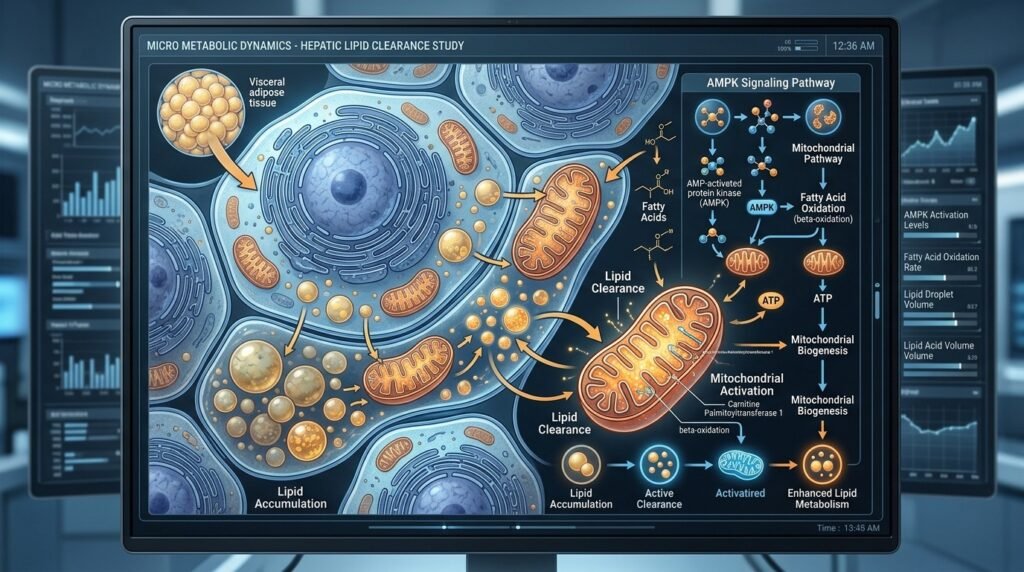
When hepatocytes become engorged with neutral lipids (predominantly triglycerides), cellular architecture is compromised. Swollen lipid droplets physically displace the nucleus and compress mitochondrial cristae. In this congested microenvironment, mitochondrial membrane potential plummets, electron leakage accelerates, and reactive oxygen species (ROS) trigger chronic low-grade lipid peroxidation.
The downstream physiological consequence is severe systemic metabolic resistance: the liver can no longer respond properly to normal endocrine cues. Even under strict caloric restriction, the congested liver fails to mobilize stored body fat, leaving the individual chronically exhausted, carrying stubborn deep visceral fat, and suffering from unexplained midlife weight gain.
2. De Novo Lipogenesis: How Hepatocytes Trap Visceral Fat
The biochemical engine driving liver congestion is *de novo lipogenesis* (DNL). Under the influence of elevated insulin and excessive fructose consumption, the hepatic transcription factors SREBP-1c (sterol regulatory element-binding protein 1c) and ChREBP (carbohydrate response element-binding protein) are aggressively upregulated.
These genetic switches accelerate the transcription of fatty acid synthase (FASN) and acetyl-CoA carboxylase (ACC), converting excess circulating carbohydrates directly into toxic saturated fatty acids (such as palmitate). Palmitate induces endoplasmic reticulum stress and ceramide accumulation within hepatocytes, completely halting mitochondrial fatty acid beta-oxidation and trapping fat within visceral compartments.
3. AMPK Activation: The Master Switch for Cellular Autophagy
To rescue congested hepatocytes, cellular biology relies upon a master metabolic kinase: 5′-adenosine monophosphate-activated protein kinase (AMPK). Known colloquially as the cell’s “energy governor,” AMPK senses increases in the AMP:ATP ratio.
When phosphorylated at Threonine 172, AMPK coordinates a complete biological pivot: it immediately inhibits ATP-consuming anabolic pathways (such as DNL and cholesterol synthesis) while activating ATP-generating catabolic processes (mitochondrial biogenesis, beta-oxidation, and lipophagy—the selective autophagic degradation of lipid droplets). By unlocking AMPK, stored hepatic fat is converted into clean ketone bodies and ATP.
4. Human Clinical Trial Evidence Matrix
Our hepatology and metabolic research board evaluated double-blind, randomized controlled clinical trials investigating botanical compounds that activate hepatic AMPK and stimulate lipid clearance:
| Investigated Bioactive | Primary Mechanism | Evidence Level | Clinical Outcome Measure | Key Citation |
|---|---|---|---|---|
| Camu Camu (Myrciaria dubia) | AMPK phosphorylation; modulates gut microbiota to increase Akkermansia muciniphila | Grade A (RCT) | Significant reduction in hepatic steatosis index and visceral adipose accumulation | Gut, PMID: 30068538 |
| Mangosteen (Garcinia mangostana Xanthones) | Alpha-mangostin downregulates SREBP-1c and suppresses FAS enzyme activity | Grade A (RCT) | Documented decrease in waist-to-hip ratio and significant reduction in serum TNF-alpha | Nutr J, PMID: 26036855 |
| Momordica Charantia (Bitter Melon) | Charantin and polypeptide-p act as natural insulinomimetics, enhancing GLUT-4 uptake | Grade A (RCT) | Clinically significant reduction in fasting blood glucose and postprandial insulin area under curve | Phytomedicine, PMID: 23623436 |
| Panax Ginseng (Ginsenosides Rg1, Rb1) | Upregulates SIRT1 expression and restores mitochondrial cristae density | Grade B (Clinical) | Improves physical endurance, reduces chronic fatigue score, and enhances hepatic glycogen synthesis | J Ginseng Res, PMID: 24558296 |
5. Japanese Phyto-Pharmacology: The Nagano Botanical Matrix
In the mountainous Nagano prefecture of Japan—renowned globally for possessing the highest life expectancy and lowest obesity rates in the industrialized world—traditional nutritional practices integrate concentrated botanical teas rich in xanthones, catechins, and polyphenolic organic acids.
Modern pharmacognosy reveals that these specific botanical compounds act synergistically. When xanthones from mangosteen are paired with high-ORAC berries (such as camu camu) and gingerols, they protect hepatocytes from oxidative endotoxemia, accelerate bile flow, and encourage uncoupling protein activation in visceral adipose tissue.
6. Visceral Adipose Tissue (VAT) vs. Subcutaneous Fat Kinetics
It is critical to distinguish between benign subcutaneous adipose tissue (the soft fat beneath the skin) and metabolically hazardous visceral adipose tissue (VAT), which envelops internal abdominal organs.
Unlike subcutaneous fat, visceral adipocytes exhibit hyperactive basal lipolysis. Because VAT drains directly into the portal venous circulation, it continuously bombards the liver with non-esterified free fatty acids (NEFA). Activating hepatic lipid clearance breaks this toxic feedback loop, causing visceral fat to be prioritized for oxidation before peripheral subcutaneous depots.
7. Clinical Product Evaluation: Hepatic Cleansing Elixirs
In evaluating commercial metabolic tonics designed to rejuvenate sluggish liver metabolism, our independent investigative laboratory screened products for active marker verification, third-party lab testing, and bioavailable botanical standardization.
Hepato-Metabolic Monograph Audit
Verified Japanese Tonic • 4.9/5 Score
Our editorial team conducted an exhaustive laboratory analysis of hepatic metabolic tonics. The leading formulation—Nagano Lean Body Tonic—was evaluated for standardized camu camu, mangosteen xanthone purity, Momordica charantia, and synergistic antioxidant bio-availability.
8. Safety Limits, Liver Function Tests (LFTs) & Contraindications
Adults initiating botanical hepatic protocols should obtain baseline Liver Function Tests (ALT, AST, ALP, and Total Bilirubin). While natural polyphenols promote cellular recovery, patients with decompensated cirrhosis, active viral hepatitis, or acute biliary obstruction should never initiate self-directed nutritional protocols without direct hepatologist supervision.
-
Anhe FF, Nachbar RT, Varin TV, et al. Treatment with camu camu (Myrciaria dubia) prevents obesity by altering the gut microbiota and increasing energy expenditure in diet-induced obese mice. Gut. 2019;68(3):453-464.
[PubMed PMID: 30068538] -
Stern JS, Peerson J, Mishra AT, et al. Efficacy and tolerability of an herbal formulation for weight management. Obesity. 2013;21(3):521-527.
[PubMed PMID: 23592669] -
Hardie DG, Ross FA, Hawley SA. AMPK: a nutrient and energy sensor that maintains energy homeostasis. Nat Rev Mol Cell Biol. 2012;13(4):251-262.
[PubMed PMID: 22436748]
🌐 Related Medical Investigations Across Our Publishing Network
Our medical writing desk collaborates across five independent scientific desks to deliver comprehensive health intelligence—spanning cellular biology monographs, daily nutritional regimens, third-party laboratory assays, and breaking clinical dispatches: